
Dryer Vent Routing Problems in Older Homes: What Homeowners Should Know
Older homes can have dryer exhaust ducts with long runs, tight bends, damaged materials, or difficult termination locations. Learn how to recognize routing problems and when repairs or rerouting may help.

Last Updated: October 23, 2026
Quick Summary
Not every older home has a dryer vent problem. But changes in appliance location, older materials, and limited space for ductwork can create exhaust routes that restrict airflow or make maintenance difficult. The best solution depends on the actual installation, not simply the home's age.
- Duct Length and Elbows: Long ducts and numerous elbows increase airflow resistance. The equivalent duct length, not just the straight-line distance, matters.
- Damaged Ductwork: Crushed or sagging ducts can restrict airflow and, under certain conditions, collect lint and moisture.
- Attic and Crawlspace Routing: Dryer exhaust ducts can pass through these areas when properly installed, but they must terminate outdoors.
- Duct Materials: Permanent dryer exhaust ductwork generally requires smooth-wall metal duct. Flexible dryer transition connectors should not be used as substitutes for permanent concealed ductwork.
- Inspection Before Replacement: Evaluate the duct's route and condition before deciding whether cleaning, repairing damaged sections, or rerouting the system is appropriate.
Table of Contents
- Why Older Homes Have Dryer Vent Routing Problems
- Common Routing Problems That Restrict Airflow
- Why Duct Length and Elbows Matter
- Dryer Vents Through Crawlspaces
- Dryer Vents Through Attics
- Choosing an Exterior Termination
- How to Evaluate the Existing Route
- A Real-World Dryer Vent Inspection
- Repair or Reroute: Practical Options
- Frequently Asked Questions
- Conclusion
Why Older Homes Have Dryer Vent Routing Problems
In some older homes, the laundry area wasn't originally designed for the dryer or layout used today. Over the years, appliances may have been moved, rooms remodeled, or exhaust ducts extended to reach a convenient outside wall or roof.
The result can be a duct that takes an unnecessarily long route or passes through spaces that are difficult to inspect. But older doesn't automatically mean unsafe. A short, correctly installed exhaust duct in an older home may perform better than a poorly routed duct in a newer one.
The questions that matter are straightforward: Is the duct correctly sized and constructed? Is it supported and connected properly? Does it exhaust outdoors? And is its route suitable for the dryer?
20260925 161802
Common Routing Problems That Restrict Airflow
Dryer vent routing problems can occur in both older and newer homes. Long duct runs, excessive bends, damaged materials, and loose connections may contribute to restricted airflow. When several of these conditions exist together, they can affect dryer performance and allow lint to accumulate more easily.
Too Many Bends or Tight Turns
A shorter, straighter route generally offers less resistance to airflow. Elbows are sometimes necessary to work around framing and other obstacles, but each fitting adds resistance. Several turns close together can make an otherwise modest-length run more demanding for the dryer.
A 90-degree elbow isn't automatically a defect. Its design, the total duct length, and the dryer's installation requirements all matter.
Crushed, Pinched, or Sagging Sections
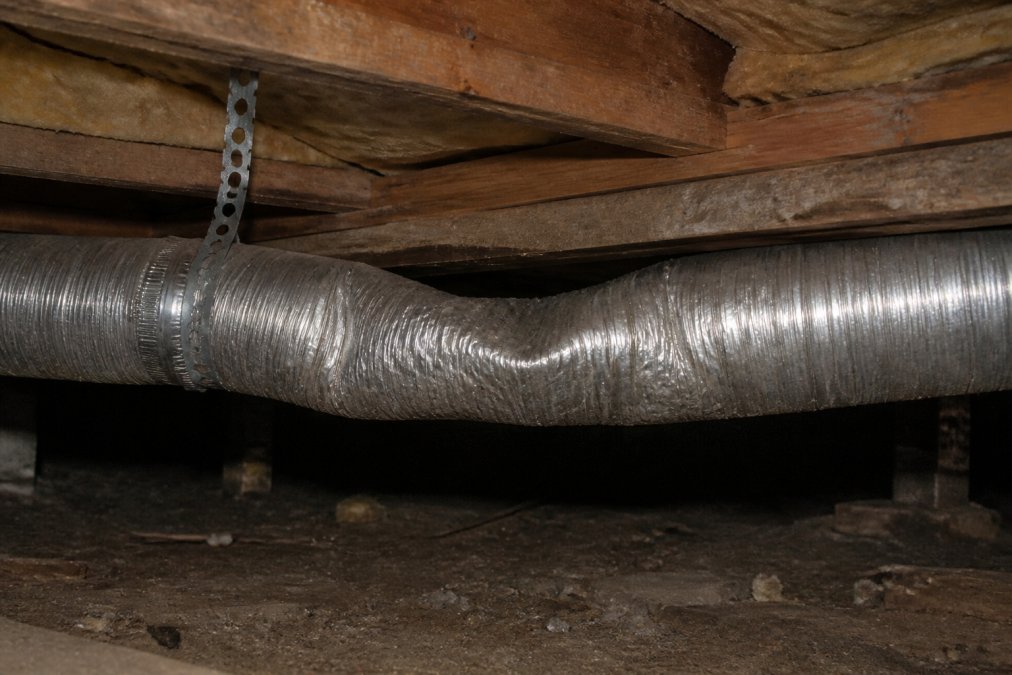
A dryer pushed too close to a wall can crush its transition connector. Ducts in crawlspaces or other accessible areas may also be damaged or poorly supported. A flattened section reduces the space available for exhaust air, while a sag may create a low point where moisture and lint collect.
The answer may be as simple as correcting a connection or replacing one damaged section, not necessarily installing an entirely new exhaust route.
Incorrect Duct Materials
The permanent dryer exhaust duct should generally be smooth-wall metal duct installed according to the applicable code and manufacturer instructions. Plastic or thin foil material should not be used as permanent concealed exhaust ductwork.
A listed flexible transition duct, used to connect the dryer to the permanent exhaust system, serves a different purpose. It should remain accessible and must not be concealed inside walls, floors, or ceilings.
Why Duct Length and Elbows Matter
A dryer exhaust duct's physical length doesn't tell the whole story. Elbows and other fittings add resistance that is accounted for through equivalent duct length.
For example, a run with 20 feet of straight duct and two elbows may be treated as longer than 20 feet when its fittings are included in the calculation. The allowance depends on the type of fitting and the applicable method used.
Under the prescriptive approach commonly used for domestic dryer exhaust ducts, the maximum straight-duct length is often 35 feet before reductions for fittings. But that number is not a universal pass/fail rule. Manufacturer instructions, approved designs, and the code provisions applicable to the installation must be considered.
A homeowner doesn't need to calculate this alone. When a dryer consistently takes too long to dry, a qualified person can evaluate the route, fittings, and equipment requirements rather than assuming lint is the only problem.
Dryer Vents Through Crawlspaces
A dryer vent can pass through a crawlspace, but the route should be carefully supported, accessible where practicable, and protected from damage. Low spots, disconnected joints, and exposure to temperature differences can contribute to trouble.
Warm, moist dryer exhaust may condense inside a sufficiently cool duct. If water collects in a sagging section, lint can stick to the damp surface and form compacted deposits. Other water sources, such as rain entering at a damaged termination, should also be considered.
Possible corrections include replacing sagging or damaged sections with appropriate smooth-wall metal duct, supporting the run correctly, and addressing the actual moisture source. Insulation may help in some conditions, but insulation by itself does not guarantee that condensation will stop.
For a more detailed explanation of moisture and wet lint, see our article, Why Standing Water Develops Inside Dryer Vents in Florida Homes.
Dryer Vents Through Attics
A dryer exhaust duct passing through an attic is not the same as a dryer vent terminating inside the attic.
A correctly installed duct may travel through an attic and then terminate outdoors through a properly designed roof or wall outlet. What should not happen is releasing hot, moist dryer exhaust directly into the attic. That can create moisture problems and leaves the exhaust in a space where it doesn't belong.
Attic routes deserve attention to duct support, materials, allowable length, insulation where appropriate, and access to the exterior termination for cleaning. A roof termination may be perfectly workable, though it can make inspection and maintenance more difficult than a readily accessible wall outlet.
Choosing an Exterior Termination
Dryer exhaust should discharge directly outdoors through a termination suitable for dryer use. The outlet must not be blocked by a screen or other restriction that can collect lint, and any damper should be able to operate as intended.
A termination's position matters, too. Openings into the building, ventilated soffits, and other nearby features may affect where it can be installed. Florida's residential code includes a 3-foot clearance from building openings, including openings in ventilated soffits, when the dryer manufacturer does not specify a location. Other applicable requirements may also apply.
Wall terminations may be easier to service, but a properly installed roof termination is not automatically wrong. The best location is one that meets installation requirements and can be maintained safely.
How to Evaluate the Existing Route
Before spending money on a replacement, identify what is actually causing the problem. Useful checks include observing whether drying times have increased, looking for a crushed transition connector, and checking whether the exterior damper opens while the dryer operates. If you notice a burning smell, smoke, or excessive heat, stop using the dryer until the cause is evaluated.
A professional assessment may include inspecting accessible connections, examining portions of the duct with a camera, and measuring airflow when conditions permit. A camera can reveal lint accumulation, water, damage, or obstructions, but tight turns and blockages may prevent it from reaching the entire system. An airflow measurement adds useful performance information; it does not, on its own, prove that every section is clean or correctly installed.
The goal is to distinguish among three different situations: a duct that primarily needs cleaning, a duct with an isolated repairable defect, or a route that needs redesign.
A Real-World Dryer Vent Inspection
During a recent dryer vent inspection, I discovered that sections of the exhaust system contained corrugated flexible ducting with several bends and turns. Although portions of the duct were clean, the configuration raised concerns about restricted airflow.
This is a good example of why cleaning isn't always the answer. Removing lint may help, but it won't correct an inefficient duct route or eliminate the resistance created by unnecessary bends and corrugated materials.
In this particular situation, I recommended replacing the problematic flexible sections with smooth-wall rigid metal ductwork to provide a more direct and reliable exhaust route.
Repair or Reroute: Practical Options
In some older homes, the building layout makes dryer vent routing more challenging. Structural limitations, appliance location, and accessibility can restrict the available options. When the existing route has problems, the goal should be to determine whether a targeted repair, material replacement, or a redesigned exhaust route offers the most practical solution.
Correct a Damaged Connection or Section
If the route is otherwise suitable, replacing a crushed transition connector, fixing an accessible separation, or replacing a damaged metal duct section may be enough. Repairs should use materials and methods approved for the application.
Upgrade Improper Permanent Ductwork
If the problem is flexible plastic or foil material used inside a concealed exhaust route, the appropriate solution may be to replace it with smooth-wall metal duct while retaining the general route, if that route is otherwise compliant.
Shorten or Simplify the Route
Sometimes a more direct path to an exterior wall reduces the number of bends and makes future maintenance easier. This may require wall or ceiling work, so the benefit should be weighed against the disruption and cost.
Confirm the Correct Duct Size
For ordinary residential dryers, do not assume that increasing duct diameter beyond the manufacturer's specified size will fix poor airflow. The size and allowable route should match the dryer and applicable requirements. Correcting an undersized or damaged section is different from arbitrarily enlarging the system.
Do Not Treat a Booster Fan as a Routine Fix
Florida's 2023 Building Code includes provisions prohibiting domestic booster fans in dryer exhaust systems (Residential Section M1502.4.8 and Mechanical Section 504.6). An inline fan should not be presented as the default answer to a long or poorly routed duct. If a system appears to require powered assistance, have a qualified professional verify the applicable code provisions and equipment design before making changes.
Consider Relocating the Dryer
In a difficult layout, moving the dryer closer to a suitable exterior wall may be more practical than maintaining an unusually complicated duct route. Relocation can require electrical, plumbing, and building work, so it is usually a larger project rather than the first step.
The best solution is the one that addresses the actual defect while providing a properly installed, maintainable exhaust route. Not every older home needs an entirely new duct system.
Frequently Asked Questions
Are older homes more likely to have dryer vent routing problems?
Some older homes have laundry-room layouts, renovations, or duct materials that make routing more complicated. Age alone doesn't determine whether the vent is properly installed. The duct's condition, configuration, and suitability for the dryer matter more.
Can a dryer vent run through a crawl space or attic?
Yes, a dryer exhaust duct can pass through either space when installed properly and terminated outdoors. It must not discharge into the crawlspace or attic. Support, duct material, routing, and access for maintenance all deserve attention.
Is a 20-foot dryer vent too long?
Not necessarily. Straight-duct length, fittings, the dryer's requirements, and the applicable code method all matter. The equivalent length may be greater than the measured straight length because elbows add resistance.
Should I replace my dryer vent if clothes take too long to dry?
Not automatically. Longer drying times can result from lint buildup, an obstructed termination, an installation issue, or a problem with the dryer itself. Diagnose the cause before deciding whether cleaning, repair, or rerouting makes sense.
Does a roof vent mean my dryer duct was installed incorrectly?
No. A roof termination can be appropriate if designed and installed correctly. It may simply require more involved access for inspection and cleaning.
Conclusion
Dryer vent routing problems in older homes don't always call for a complete replacement. A damaged connector may need a straightforward repair; an obstructed duct may benefit from cleaning; and a poorly designed route may need a more substantial change.
What matters is identifying the condition first. By looking at duct material, connections, bends, length, moisture, and exterior termination, homeowners can make better decisions about what their dryer exhaust system actually needs.
