
How Often Should Dryer Vents Be Cleaned? A 2026 Guide

Table of Contents
- How Often Should Dryer Vents Be Cleaned? A Practical Baseline
- Signs a Dryer Vent Needs Cleaning Before Your Next Scheduled Service
- What Changes the Schedule: Household Size, Vent Length, and Duct Material
- How to Clean a Dryer Vent: What DIY Covers and What It Misses
- How Long Does Dryer Vent Cleaning Take?
- Seasonal Maintenance Checklist and Error Codes That Signal a Clogged Vent
- Conclusion: Set a Schedule You Will Actually Keep
- Frequently Asked Questions
Last Updated: October 9, 2026
How Often Should Dryer Vents Be Cleaned? A Practical Baseline
The short answer: how often should dryer vents be cleaned depends on your setup, but most homes need a full cleaning once a year. Households with heavy laundry loads, long vent runs, or older flexible ducting should be cleaned every six to nine months.
The dryer is one of the hardest-working appliances in your home. It also carries one of the most overlooked fire risks. Lint is highly flammable, and when it collects inside the exhaust system, airflow drops and heat builds. That combination is what turns a routine chore into a household safety issue.
Below, we break down where the one-year rule comes from, when it fails, and how to build a schedule you will actually keep.
The One-Year Rule and Where It Comes From
The annual cleaning guideline is a general recommendation, not a universal law. It assumes an average household: four people, a standard-length vent run, and a dryer used a few times a week.
Under those conditions, lint buildup stays manageable for about twelve months. The U.S. Fire Administration's residential fire data shows that dryer fires remain a recurring cause of home fires, and failure to clean the vent is the leading factor.
That is the logic behind the rule. It is a starting point, not a finish line.
When Once a Year Is Not Enough
A yearly cleaning can be too little for some homes. A common mistake is treating the calendar as the only trigger.
You likely need more frequent service if any of these apply:
- Five or more people live in the home
- You run three or more loads per day
- The vent run is longer than 25 feet
- Your ducting is flexible foil or plastic rather than rigid metal
- You have pets that shed heavily
- Your laundry room feels humid or hot after a cycle
For these households, a six-month schedule is the safer bet. A property manager with dozens of units should treat each building on its own timeline, not one blanket date.
Signs a Dryer Vent Needs Cleaning Before Your Next Scheduled Service
Watch the machine, not just the calendar. Your dryer tells you when the vent is struggling, often weeks before a scheduled service.
The most reliable signs a dryer vent needs cleaning are:
- Clothes take two or more cycles to dry
- The dryer feels hot to the touch on top
- The laundry room stays humid or smells musty
- The lint screen fills faster than usual
- You notice lint around the vent hood outside
- The vent flap does not open fully during a cycle
- A burning smell appears near the back of the dryer
Any one of these means airflow is restricted. Two or more means you should stop using the dryer until the vent is checked.
What Changes the Schedule: Household Size, Vent Length, and Duct Material
Three factors drive your real schedule: how much you dry, how far the air travels, and what the air travels through. Change any one of them and the timeline shifts.
Here is how each factor moves the needle:
Factor | Low Frequency | High Frequency |
|---|---|---|
Household size | 1-2 people | 5+ people |
Loads per week | Under 8 | 20+ |
Vent length | Under 15 feet | Over 25 feet |
Duct material | Rigid metal | Flexible foil or plastic |
Pets | None | Heavy shedders |
The U.S. Consumer Product Safety Commission guidance on dryer safety notes that longer vent runs and flexible ducting trap more lint. Both raise your risk, and both shorten the time between cleanings.
Why Rigid Metal Ducting Beats Flexible Transition Hose
Rigid metal ducting has smooth walls, so lint slides through instead of catching. Flexible transition hose has ridges, and every ridge is a place for lint to snag.
A short piece of flexible hose behind the dryer is fine. A full run of it is not. If your vent uses flexible foil or plastic for its entire length, expect to clean it more often, and plan to replace it with rigid metal when you can.
How to Clean a Dryer Vent: What DIY Covers and What It Misses
A basic DIY cleaning handles the easy parts. A vent cleaning kit with a brush and a shop vacuum can clear the transition hose and the first few feet of duct.
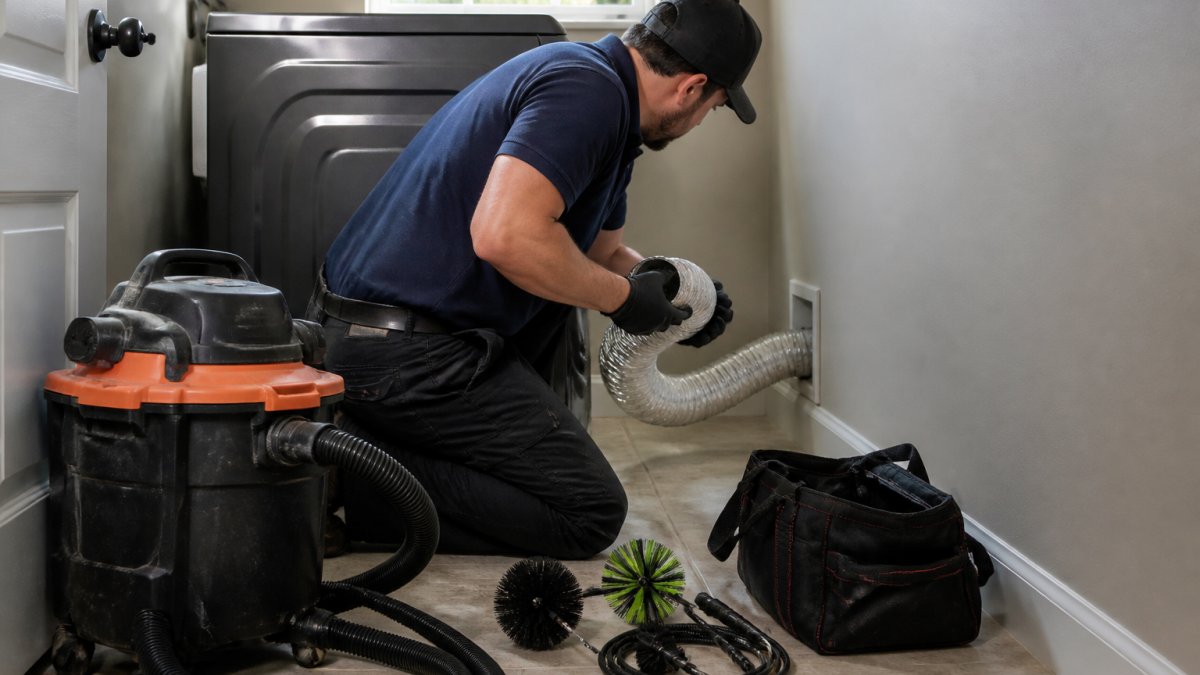
Here is what most homeowners can do:
- Unplug the dryer and pull it away from the wall
- Disconnect the transition hose and vacuum out loose lint
- Run a vent brush through the hose and the first section of duct
- Clean the lint screen housing and the outdoor vent hood
- Reconnect everything and check that the flap opens freely
What DIY misses is the middle and far end of the run. Long ducts, elbow joints, and second-floor runs hide lint that a handheld brush cannot reach. That hidden lint is exactly where airflow restriction and fire risk build up.
That is the part most guides skip. A brush kit cleans what you can see. A camera inspection and rotary-brush cleaning reach what you cannot.
How Long Does Dryer Vent Cleaning Take?
A standard residential cleaning takes about 45 to 90 minutes. How long does dryer vent cleaning take on a complex job? Longer runs, roof-level vent terminations, or heavy buildup can push a visit past two hours.
Most of that time goes to setup and inspection, not the cleaning itself. A technician has to move the dryer, run a camera through the duct, and confirm airflow before and after.
For multi-unit properties, timing scales with unit count. A property manager with 40 units should expect a full day or more, split across buildings.
What a Clogged Vent Costs You Every Month
The time a cleaning takes is small compared to what a clogged vent costs in energy. A dryer fighting restricted airflow runs longer per load, and that extra runtime shows up on your utility bill.
The mechanism is straightforward: lint buildup reduces airflow, the drum stays humid, and the moisture sensor keeps the cycle running. A load that should take 40 minutes stretches to 60 or 70.
A common pattern is that after a full vent cleaning, drying times drop noticeably and the dryer cycles less often. The U.S. Department of Energy's appliance energy guidance explains how venting affects dryer efficiency, and the takeaway is simple: restricted airflow is wasted energy.
There is also a repair-cost angle. A dryer that overheats because of a blocked vent can blow its thermal fuse or high-limit thermostat.
Seasonal Maintenance Checklist and Error Codes That Signal a Clogged Vent
A seasonal rhythm keeps you ahead of buildup. Pair it with your existing home maintenance and it becomes automatic. The key is to match the task to the season's actual risk, not just repeat the same check four times.
Use this checklist:
- Spring: Pull the dryer out and inspect the transition hose for kinks or crushing; check the outdoor vent hood for bird nests, wasp nests, and debris that winter storms pushed in
- Summer: During peak laundry season, time a normal load once a month. If drying time creeps up by 10 minutes or more versus your baseline, airflow is dropping
- Fall: Schedule a full professional cleaning before heavy winter use; cold, dense outdoor air makes a partially blocked vent far more obvious
- Winter: Watch drying times closely and check the exterior hood after ice or snow; a frozen or stuck flap is a common cold-weather blockage
Error Codes That Point to a Vent Problem, Not a Broken Dryer
Many modern dryers display a code when airflow drops. The exact code varies by brand, but the pattern is consistent: codes tied to restricted venting, long dry times, or overheating usually mean the vent, not the machine.
Common patterns to recognize:
- "Check vent" or "vent blocked" messages on many newer models are the most direct signal. The machine has detected reduced airflow and is telling you to inspect the duct before anything else.
- Overheating or high-limit codes often appear when heat cannot escape because lint is restricting the exhaust. The dryer's safety thermostat trips, and the machine shuts down mid-cycle.
- Long-dry-time or moisture-sensor codes show up when the sensor never detects dryness because humid air is not leaving the drum fast enough.
- Thermal fuse failures are not a code but a symptom. If the thermal fuse blows repeatedly, restricted airflow is a leading cause, and replacing the fuse without clearing the vent just repeats the failure.
Treat any airflow-related code as a reason to inspect the vent before calling for a repair. A technician who replaces a part without checking the duct is treating the symptom, not the cause. Check your dryer's manual for the exact meaning of your model's code, then verify the vent is clear before assuming the appliance is at fault.
Conclusion: Set a Schedule You Will Actually Keep
The hardest part of vent maintenance is not the cleaning. It is remembering to do it before something goes wrong. A dryer that runs hot, takes two cycles, or smells musty is asking for help.
At Clear Flow Jax LLC, we make that schedule easy to keep. As an owner-operated local business, we use camera inspections and airflow testing to show you exactly what is inside your vent, not just tell you it needed work. Our rotary-brush and vacuum equipment clears the full run, and we document every job so homeowners and property managers have proof of the service.
Get started with Clear Flow Jax LLC and protect your home with a vent schedule built around your actual laundry habits.
Frequently Asked Questions
How do I know if my dryer vent needs cleaning?
Watch for clothes that take two or more cycles to dry, a drum that feels unusually hot, a burning smell, or the outside vent hood flap not opening fully during a cycle. Visible lint around the vent termination or moisture on the laundry room walls also point to a blockage. If you notice any of these signs a dryer vent needs cleaning, schedule service rather than waiting for your annual date. A camera inspection confirms what is actually inside the duct.
Can I clean out my dryer vent myself?
You can handle part of it. Pull the dryer out, disconnect the flexible transition hose, and vacuum the lint from both the hose and the dryer's rear exhaust port. A vent cleaning kit with a brush auger can reach a short, straight run. What DIY rarely handles is a long duct, multiple elbow joints, or a second-floor roof termination. Those need rotary-brush equipment and airflow testing to confirm the blockage is actually gone.
Does a dryer vent need to be cleaned every year?
For most households, yes. A single-family home with four or more people doing daily loads should be cleaned annually. Larger households, homes with long vent runs, and buildings where the duct terminates on the roof may need service every six to nine months. Commercial and multifamily laundry rooms often need quarterly attention because the volume of lint produced is far higher than a residential setup.
Should dryer vents be cleaned more often in a large household?
Yes. Lint accumulates in proportion to how many loads you run, not how many months have passed. A family of six running two loads a day pushes roughly four times the lint through the duct as a couple doing laundry twice a week. In those homes, a six-month interval is more realistic than twelve. Property managers with shared laundry rooms should treat quarterly cleaning as the baseline.